Piano Roll in FL Studio 2025
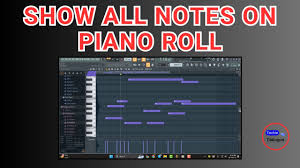
The Piano Roll in FL Studio is one of the most powerful and essential tools for modern music production. Whether you’re creating melodies, chords, basslines, 808 slides, MIDI patterns, drums, automation, or advanced note editing, the Piano Roll gives you complete control over every aspect of your musical composition. It’s widely considered one of the best MIDI editors in any DAW, thanks to its intuitive design, deep features, and unmatched flexibility.
From simple note placement to complex sound design and humanization, understanding how to use the Piano Roll effectively can completely transform your workflow. This guide explains everything you need to know — including the main functions, tools, shortcuts, tips, tricks, and advanced techniques for building professional MIDI patterns Piano Roll in FL Studio.
What Is the Piano Roll in FL Studio?
The Piano Roll is FL Studio’s MIDI editor. It allows you to:
- Place notes
- Create melodies
- Draw chords
- Edit velocities
- Adjust timing
- Add slides & automation
- Design drum patterns
- Control every MIDI parameter
It works with all FL Studio instruments and VST plugins, making it a universal workspace for musical creativity. Each note behaves like a MIDI instruction, telling your instrument when to play, how loud to play, and what pitch to use.
How to Open the Piano Roll
There are multiple ways to open the Piano Roll in FL Studio:
Method 1: Right-click any instrument in Channel Rack → Piano Roll
This is the simplest and most common method.
Method 2: Press F7 on your keyboard
Instant shortcut for opening the current instrument’s Piano Roll.
Method 3: Click the Piano Roll icon above the Channel Rack
Located next to the Step Sequencer toggle.
Method 4: Double-click a note region
Works especially when using MIDI clips in the Playlist.
Knowing these shortcuts makes your workflow faster and smoother.
Understanding the Piano Roll Interface
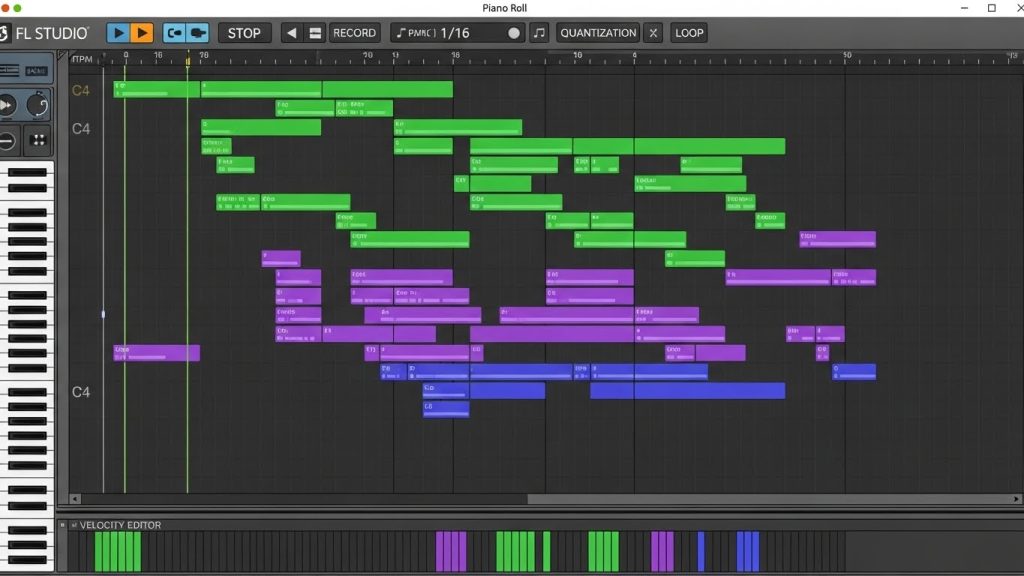
The Piano Roll interface contains several tools and controls:
3.1 Keys and Grid
On the left, you’ll see piano keys representing musical pitch.
The main grid represents timing, beats, and measures.
3.2 Note Properties
Each note contains:
- Pitch
- Length
- Velocity
- Pan
- Release
- Modulation
3.3 Toolbar Tools
Includes:
- Draw tool
- Paint tool
- Delete tool
- Slice tool
- Select tool
- Zoom tool
Each tool serves a different purpose in editing MIDI patterns.
3.4 Control Panel (Bottom Area)
This is where you can adjust:
- Velocity
- Pitch bend
- Mod X
- Mod Y
- Pan
- Note release
This area is essential for expressive performances.
How to Add Notes Piano Roll in FL Studio
Adding notes is simple:
- Choose the Draw Tool (Pencil)
- Click anywhere on the grid
- Drag horizontally to change note length
- Drag vertically to change pitch
Drawing Multiple Notes
Use the Paint Tool for repeating notes (great for hi-hats & rolls).
Adjusting Notes
- Move: Left-click and drag
- Duplicate: Shift + Drag
- Delete: Right-click
Building Melodies in the Piano Roll
Melodies are the foundation of most tracks, and Piano Roll in FL Studio makes them easy to create.
Tips for Better Melodies
- Use a scale (like minor or major)
- Keep melodies simple
- Add small pitch jumps for emotion
- Use velocity differences for realism
- Start with a chord progression as a guide
Using FL Studio Scale Highlighting
- Piano Roll → Helpers
- Enable Scale Highlighting
- Choose:
- Major
- Minor
- Dorian
- Harmonic Minor
- Pentatonic
This prevents wrong notes and helps beginners stay in key.
Creating Chords Piano Roll in FL Studio
Chords add harmony and emotion.
Basic Triads
A simple triad uses:
- Root
- Third
- Fifth
How to Create Chords Quickly
FL Studio includes tools that speed up chord creation:
Method 1: Stamp Tool
- Click the Stamp icon in Piano Roll
- Choose:
- Major
- Minor
- 7th
- Suspended
- Diminished
Method 2: Manual Building
Use intervals:
- Major chord: 0 – 4 – 7
- Minor chord: 0 – 3 – 7
- 7th chord: 0 – 4 – 7 – 10
Flipping Chords for Better Sound
Use Chord Inversions:
- First inversion
- Second inversion
- Spread notes for wide sound
Inversions prevent muddy bass and create smoother progressions.
Designing 808s & Basslines Using Piano Roll
Trap and hip-hop producers heavily rely on the Piano Roll for 808 slides and bass patterns.
Creating an 808 Pattern
- Load an 808 sample or synth
- Open the Piano Roll
- Draw notes matching your chord progression
- Adjust velocity for punch
Adding 808 Slides
Use:
- Slide notes (S-shaped icon)
- Glide notes in plugins like Sytrus or Vital
Slides make your 808s more expressive and modern.
Drum Programming in the Piano Roll
While the Step Sequencer is good for simple drums, Piano Roll gives more precision.
Why Use Piano Roll for Drums?
- Better timing control
- Better velocity variation
- Easier rolls and fills
- Perfect for trap hi-hats
Creating Trap Hi-Hat Rolls
- Select hi-hat channel
- Highlight desired grid size (1/3, 1/4, 1/8, 1/16, 1/32)
- Draw repeated notes
- Add velocity variation
- Create stutters using the Chop Tool
The Chop Tool (Alt + U)
This automatically creates rolls.
The Randomizer Tool (Alt + R)
Adds:
- Velocity variation
- Timing variation (human feel)
Useful Tools Inside Piano Roll
FL Studio includes powerful tools hidden inside dropdown menus.
9.1 Chop Tool
Shortcut: Alt + U
Creates:
- Hi-hat rolls
- Arps
- Repeating patterns
9.2 Strum Tool
Shortcut: Alt + S
Creates natural guitar-like chord strums.
9.3 Flam Tool
Shortcut: Alt + F
Adds quick drum flams often used in EDM and trap.
9.4 Quantize Tool
Shortcut: Alt + Q
Snaps your notes to the nearest grid point.
9.5 Arpeggiator
Shortcut: Alt + A
Turns chords into running arpeggios.
9.6 Randomizer
Shortcut: Alt + R
Adds random:
- Pitches
- Velocities
- Pan movements
Useful for lo-fi and ambient production.
Working with Ghost Notes
Ghost notes allow you to see notes from other patterns or channels—very useful for layering.
Enable Ghost Notes
Piano Roll → Helpers → Ghost Channels
Use ghost notes to:
- Build melodies that follow chords
- Create basslines that match roots
- Layer instruments with tight timing
MIDI Tools & Shortcuts Every Producer Should Know
Here are essential shortcuts to speed up your workflow:
Note Control
- Move note: Arrow keys
- Duplicate: Shift + Drag
- Delete: Right-click
- Select all: Ctrl + A
- Shorten/lengthen: Alt + Drag
Navigation
- Zoom: Ctrl + Mouse Wheel
- Quick zoom horizontal: Middle Mouse Click
Scale & Key Tools
- Stamp Tool for instant chords
- Scale Highlighting to avoid wrong notes
Editing
- Alt + Q → Quantize
- Alt + A → Arpeggiator
- Alt + X → Scale levels
- Alt + Y → Flip horizontally or vertically
Mastering shortcuts speeds up your creativity.
Humanizing Notes for Realistic Performances
Perfectly aligned MIDI sounds robotic. Humanization adds emotional depth.
How to Humanize Notes
- Randomize velocity
- Shift notes slightly off beat
- Vary note lengths
- Use subtle pitch changes (Mod X / Mod Y)
- Slide notes for expression
This is especially important for:
- Piano melodies
- Guitar emulation
- Lo-fi chords
- Trap hi-hat patterns
Using the Piano Roll in Playlist Workflow
You can control how your pattern appears inside the Playlist.
Pattern vs. Audio Clip
- Piano Roll creates MIDI patterns
- Playlist arranges them
Converting MIDI to Audio
- Right-click pattern
- Render to audio clip
Useful for CPU saving and sound design.
Advanced Techniques for Professional Results
14.1 Layering Instruments with Ghost Notes
Copy or align notes across instruments.
14.2 Creating Counter-Melodies
Use existing melody notes as visual guides.
14.3 Using LFO-style Automation Notes
Piano Roll can automate:
- Pitch
- Mod X
- Mod Y
- Velocity
14.4 Creating Glides and Slides
Many VSTs respond to overlapping notes.
15. Common Mistakes to Avoid
Beginners often make these errors:
❌ Overdrawing too many notes
❌ Forgetting to adjust velocity
❌ Using wrong grid settings
❌ Making melodies too busy
❌ Not staying in key
❌ Relying only on quantization
❌ No human feel
❌ No structure or progression
Avoid these and your MIDI patterns will sound cleaner and more professional.
Final Thoughts
The Piano Roll in FL Studio is one of the most powerful creative tools available to music producers. It offers unmatched flexibility for designing melodies, chords, basslines, 808 slides, drum patterns, arpeggios, and advanced MIDI compositions. Whether you’re just starting or already producing professionally, mastering the Piano Roll will dramatically improve your workflow, creativity, and the overall quality of your music.
With tools like humanization, ghost notes, chords stamping, velocity editing, and dozens of shortcut commands, the Piano Roll helps you turn musical ideas into polished, expressive compositions. The deeper you explore it, the more creative possibilities you unlock.